
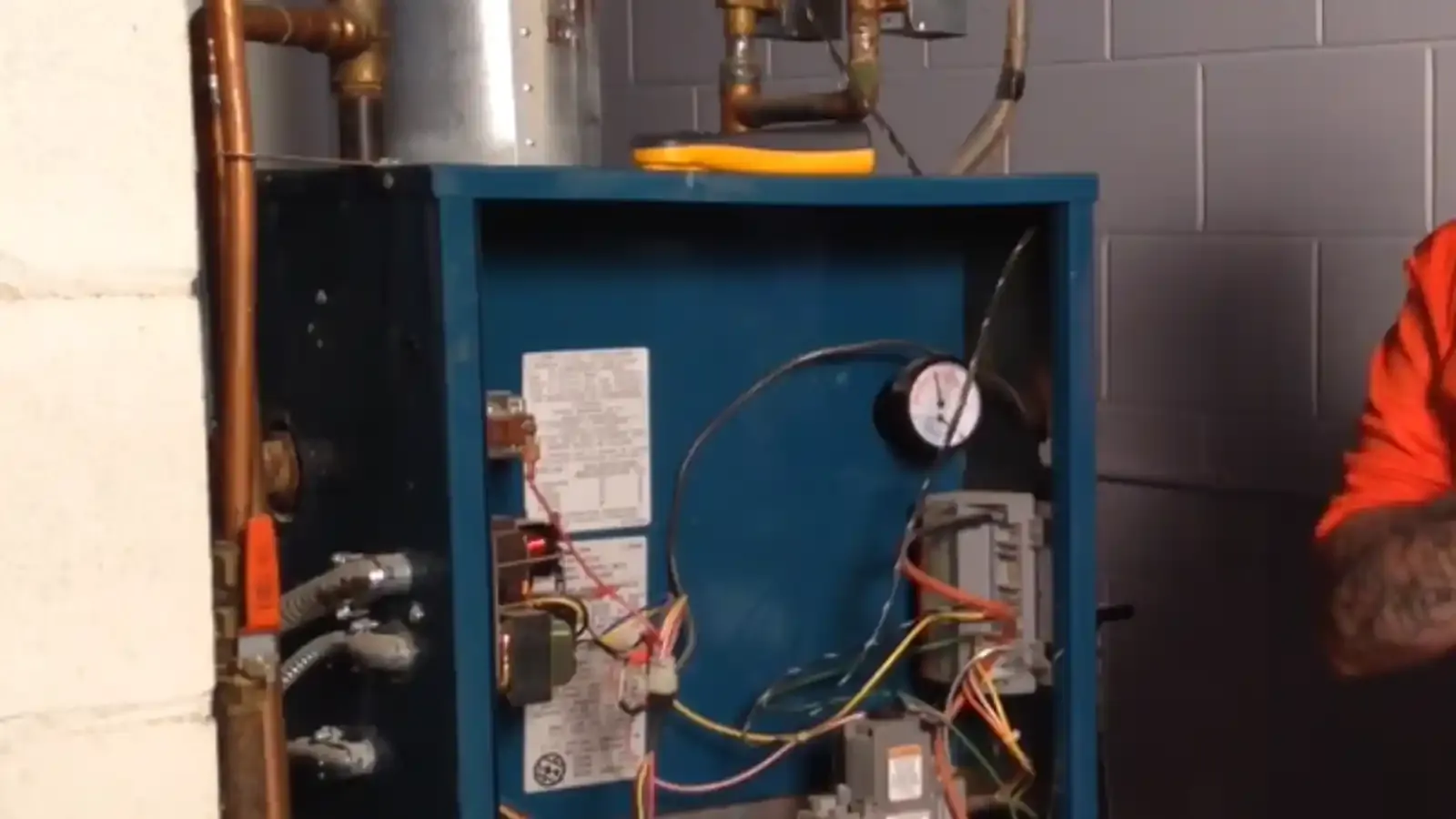
Five Quick Checks
Thermostat
Make sure it is set to heat and a few degrees above room temperature. Replace batteries if it has them.
Power
Check the switch near the boiler and the breaker.
Gas
If a gas stove works, the supply is probably on.
Pressure gauge
A cold residential boiler is typically 12 to 15 psi. Below about 10 may lock out.
Display or lights
Note any error code before you reset anything.
If the boiler is locked out, press reset once. Pressing it repeatedly can flood the burner with gas. If it locks out again, stop and call.
Common Boiler Faults
| Symptom | Likely cause | Fix |
|---|---|---|
| No heat, error code | Dirty flame sensor or ignition fault | Clean or replace sensor |
| Pressure drops | Leak or failed expansion tank | Find the leak, replace tank |
| Banging or kettling | Scale, sludge or trapped air | Flush and bleed |
| Cold radiators at top | Air in system | Bleed radiators |
| Water on the floor | Valve or pump seal | Replace part |
Safety Comes First
Gas boilers produce carbon monoxide if combustion is poor or venting is blocked. Have working carbon monoxide detectors on every level and near bedrooms. If an alarm sounds, leave the house and call 911.
A gas smell means leave the building and call 911 and the gas utility from outside. Do not turn lights or switches on or off.
Types of Residential Boilers
Hot water boilers feed radiators, baseboards or in-floor tubing. Steam boilers feed radiators with steam and have different controls and safety devices. Older boilers are often cast iron and vent up a chimney. Newer high-efficiency condensing boilers vent through PVC and produce acidic condensate that needs a drain.
Knowing which type you have helps a technician bring the right parts. The label on the boiler lists the brand, model, fuel and input rating.
Reading the Pressure Gauge and Expansion Tank
A hot water system is filled to roughly 12 psi when cold, and the pressure rises as the water heats. If the pressure climbs past about 25 psi when hot and the relief valve opens, the expansion tank may be waterlogged.
If the gauge falls toward zero, water is leaking somewhere. Look at the boiler, the pump, the radiator valves and any pipes in the ceiling below baseboards.
What a Boiler Repair Costs
Small repairs such as cleaning a sensor or replacing a pump commonly cost a few hundred dollars. A failed heat exchanger or a boiler beyond reasonable parts support usually means replacement.
We tell you the price of the repair and, when relevant, the price of a replacement, so you can decide before the next cold snap.
Protect the Pipes While the Boiler Is Down
Stay warm in one room
Close doors to rooms you do not use and keep the family in a room with a safe source of heat.
Open cabinet doors
Let house air reach pipes on exterior walls under sinks.
Let a tap drip
A thin stream from a faucet on an exterior wall keeps water moving.
Use portable heat carefully
Keep electric heaters away from bedding and curtains, and never use an oven, grill or camp stove for heat indoors.
Know your shutoff
If a pipe does freeze and split, closing the main stops the damage.
Questions Worth Asking Your Technician
Ask what failed, whether the part is likely to fail again and what the system pressure was when they arrived. Ask whether the venting and the carbon monoxide readings were checked.
If the boiler is more than 15 years old, ask what replacement would involve and what it would cost. Having the number in hand turns the next failure from a crisis into a decision.
Signs Your Boiler Is Near the End
Repeated repairs in a few years
The cost of keeping it going is climbing.
Rust or corrosion on the heat exchanger
Leaks cannot be repaired economically.
Rising fuel bills
An old boiler loses efficiency.
Parts no longer available
A repair may not be possible.
What to Write Down Before the Call
Note the boiler brand, the model number on the data plate and any error code on the display. Also note the water pressure on the gauge, which usually sits near 12 to 15 psi when the system is cold.
A photo of the front panel and the pressure gauge helps the plumber bring the right parts the first time. It also saves a trip when the fix is a simple reset.
Boiler down and the house cooling?
Call now with the brand and what you see.
Preventive Care
A yearly service checks the burner, flame sensor, venting, pressure and safety controls. Bleed radiators at the start of winter and keep the area around the boiler clear.
If your system is older than 15 to 20 years or needs repeated repairs, ask for a replacement quote so you can choose rather than be forced into it on the coldest day.
Our boiler repair service diagnoses most residential boilers. Frozen or split pipes after a failure are handled by burst pipe repair. We serve Chaska, Chanhassen and Waconia.
Choosing a Licensed Contractor in Minnesota
Minnesota licenses plumbing contractors and workers through the Department of Labor and Industry, which offers a free license and registration lookup online with a guest option. It is worth checking any contractor before they work on a heating system.
The City of Chaska also requires a plumbing permit for installation or alteration of plumbing, and a boiler replacement will involve one.
Boiler piping and relief valves fall under the Minnesota Plumbing Code, based on the Uniform Plumbing Code (UPC), along with the manufacturer's installation instructions.
Source: Minnesota Department of Labor and Industry license lookup, City of Chaska plumbing permit information.
Questions Chaska Homeowners Ask
Turn off the boiler, open the bleed valve with a key until water spits, and close it. Check the boiler pressure afterward.
Typically 12 to 15 psi when cold. Check your manual.
Usually scale, sludge or air. A flush and bleed often fixes it.
Once a year.
Yes. The City requires a plumbing permit for installation or alteration of plumbing.
A slow leak is more common, but a burst fitting can flood fast. Shut off the water feed and call.