
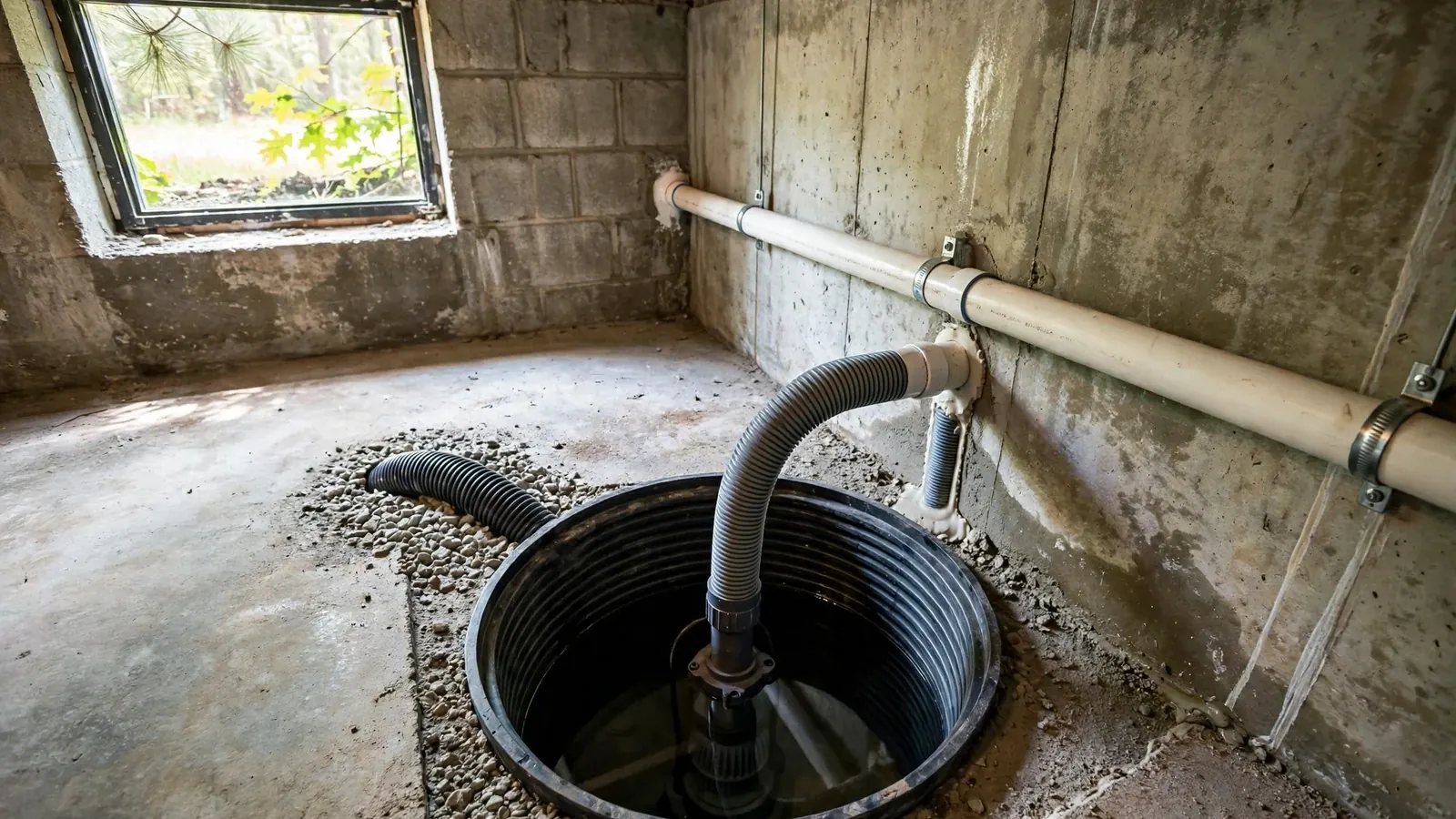
What a Sump Pump System Does
Groundwater pushes against basement walls and floors. In many homes, perforated drain tile around the footing collects that water and carries it to a pit. A pump in the pit switches on when the water rises and sends it outside through a discharge pipe.
Without a pump, that water has nowhere to go but up through the floor-wall joint, the floor cracks or the drain. With a pump, the pit stays low and the floor stays dry.
The Parts of a Good Installation
| Part | What it does | What to look for |
|---|---|---|
| Sump pit | Collects water from drain tile | At least 18 inches wide, sealed lid if radon or humidity matters |
| Submersible pump | Moves water out of the pit | Cast iron or thermoplastic housing, vertical float |
| Check valve | Stops water from flowing back | Quiet spring-loaded type |
| Discharge line | Carries water outdoors | Slopes away from the house, ends 10 or more feet out |
| Battery backup | Runs when power fails | Separate pump and a deep-cycle battery |
A pump that is too small cycles constantly and wears out early. A pump that is too large short-cycles. We size by the pit, the water table and the discharge height, not by a single price point.
Where the Water Goes Matters
The discharge pipe should run outside, then shed water onto lawn that slopes away from the foundation. Water that returns to the foundation just cycles back into the pit.
In winter, discharge lines can freeze at the outlet. A discharge that ends in a pipe with a small gap or a freeze-resistant fitting stays open when the line ices.
Tile and pit already exist
A replacement pump is a short job. A new pump, check valve and discharge adjustments often take a couple of hours.
No pit yet
We cut the slab, dig the pit, connect drain tile and pour back the concrete. That is a one to two day job.
Water comes from one wall only
A localized crack may need injection or exterior regrading before a pump is the answer.
Floor drain backs up
The problem may be the sewer, not groundwater. A pump will not fix it.
Sizing the Pit and the Pump
Most residential pumps are one-third or one-half horsepower, and the right one depends on how fast the pit fills and how high the water must be lifted. A pit about 18 inches wide and 24 inches deep gives the pump room to cycle without short-cycling.
A pump should rest on a firm base, not gravel, because stones get pulled into the intake. The float needs room to rise and fall without touching the pit wall, or it will stick and fail to start.
Mistakes That Make a New Sump Fail
No check valve
Water in the discharge pipe runs back into the pit every cycle, so the pump runs twice as often.
Discharge too close to the house
Water dumped within a few feet of the wall soaks back into the drain tile.
Pit without a lid
An open pit adds humidity to the basement and lets debris in.
Single pump on a critical basement
One pump is one failure point. A second pump or a battery backup is cheap insurance.
How Long the Job Takes
Swapping a pump in an existing pit takes a couple of hours. Cutting the slab, setting a new pit and connecting drain tile takes one to two days, followed by curing time for the concrete. We cover the floor and protect finished areas while we work.
Want a sump system priced?
Call and tell us whether you have a pit already. We will outline the options.
What Installation Costs
A replacement pump in an existing pit commonly costs a few hundred dollars up to about $1,200 in typical US pricing. A new pit with drain tile can run several thousand, and a battery backup is an add-on.
The big variables are the length of tile, the slab thickness, the discharge route and whether the pit must be sealed. Ask for a written scope and a price that lists each part.
Test It Before You Need It
Pour a bucket of water into the pit each spring and watch the pump start, empty the pit and shut off. Check that water runs out of the discharge pipe. Test the backup by unplugging the main pump.
A pump you have never tested is a pump you cannot trust on the night of a storm. If yours fails the test, our sump pump repair service replaces it before the next rain.
We install and service sumps in Chaska and nearby towns, including Victoria, where lakes keep the water table high, and Carver, close to the river. For wet walls that a pump alone does not solve, basement waterproofing covers drain tile and sealing.
Chaska Sump Discharge Rules
The City of Chaska says water from groundwater sump pumps cannot be pumped into the sanitary sewer. Discharge goes outside, to the yard or storm drainage, and not into a floor drain or a laundry sink.
Chaska sits close to the Minnesota River, and spring thaws and heavy rains raise groundwater. Plan the discharge route before you pick a pit location.
Pump installation and discharge piping follow the Minnesota Plumbing Code, based on the Uniform Plumbing Code (UPC), along with Chaska's rule against sanitary sewer discharge.
Source: City of Chaska sanitary sewer and sump pump guidance.
Questions Chaska Homeowners Ask
No. The City of Chaska says water from groundwater sump pumps cannot go into the sanitary sewer. Route discharge outside.
Plumbing work may need a permit in Chaska, depending on scope. Call the City inspections office at 952-448-9395 or ask us.
Typically seven to ten years, less if it runs constantly. Test it each spring.
Storms that fill the pit often cut power too, so a backup is a sensible addition for finished basements.
That may be humidity or condensation, which a dehumidifier or vapor barrier solves.
Replacing a pump is manageable for a handy owner. Cutting a slab, setting tile and running discharge is best left to a plumber.