
What the Relief Valve Does
The valve sits on the side or top of the tank. If the water temperature goes above about 210 degrees or the pressure exceeds a set limit, usually 150 psi, the valve opens and releases water through a discharge pipe.
That release prevents the tank from rupturing. A water heater without a working relief valve can become a hazard.
Why Relief Valves Leak
Thermal expansion
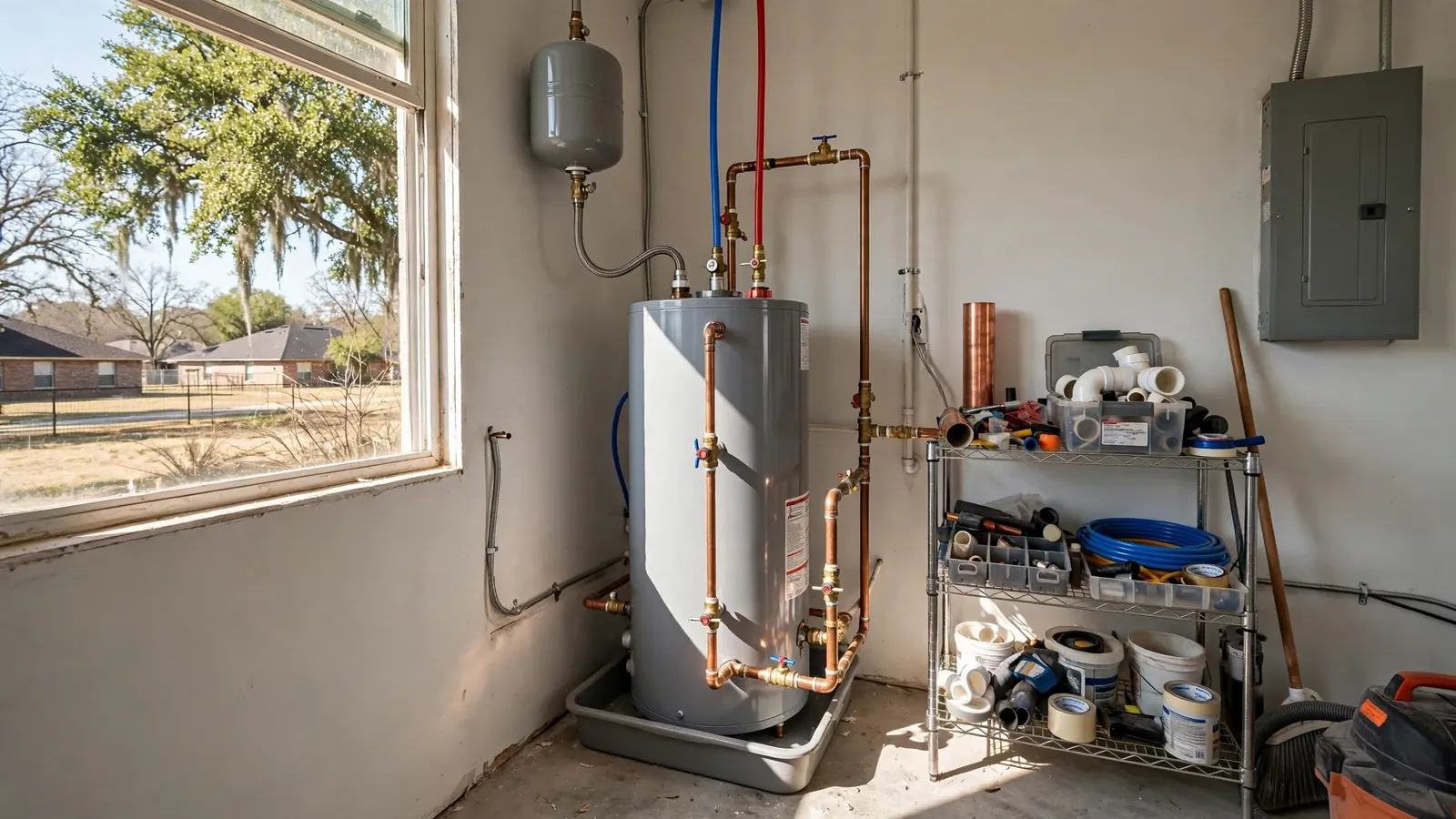
In a closed plumbing system, heated water expands and pressure rises. The valve weeps to relieve it. An expansion tank is the cure.
High household pressure
Street pressure above 80 psi stresses fixtures and the valve.
Worn seat or sediment
Scale prevents the valve from sealing.
Overheating
A bad thermostat or element can heat water past safe limits.
Test the valve once a year by lifting the lever briefly with a bucket under the discharge pipe. If water flows and stops, it is working. If it keeps dripping afterward, the valve needs replacing.
How Replacement Works
Shut off power or gas
And close the cold water inlet.
Relieve pressure
Open a hot tap and drain a few gallons below the valve level.
Remove the old valve
Unscrew it and the discharge pipe.
Install the new valve
Use the correct rating, thread sealant and a proper discharge pipe.
Refill and test
Open the cold inlet, bleed air from a hot tap and check for leaks.
Reading What the Discharge Pipe Tells You
A drip that appears only while the heater is heating, then stops, is usually thermal expansion in a closed system. A drip that never stops points to a worn seat or a pressure problem. A steady flow or steam points to overheating, which is an emergency.
Put a bucket or a clear bowl under the pipe and watch for a day. Note when it drips and how much, and tell your plumber. It narrows the cause quickly.
Check Your House Pressure
A simple gauge that screws onto a hose bib shows the household water pressure. Most homes run well between 40 and 60 psi. Plumbing codes treat 80 psi as the upper limit, and higher pressure shortens the life of fixtures and the heater.
If the gauge reads high, a pressure reducing valve near the main fixes it. If the reducing valve is already installed, it may have failed, and replacing it often ends the relief valve drip.
Why We Often Replace the Expansion Tank Too
An expansion tank has an air bladder that loses charge over the years. A waterlogged tank cannot absorb expansion, so the relief valve opens instead. Tap the tank. If it sounds solid all the way down, the bladder has failed.
Replacing a failed tank is a small job and can stop the dripping that people blame on the valve.
Rules for the Discharge Pipe
It runs downward
The pipe leaves the valve and slopes down so water cannot pool.
It ends where it can be seen
A pipe ending a few inches above a floor drain shows a drip immediately.
It has no valve or cap
Anything that can block the pipe defeats the safety device.
It is the same size as the valve outlet
Narrowing the pipe slows the release.
What Replacement Costs
The valve itself is inexpensive. A service visit to replace it commonly costs about $150 to $300 in typical US pricing, higher if the expansion tank or a pressure reducing valve also needs replacing.
If the heater is more than ten to twelve years old, we will tell you honestly when replacing the whole heater would be a better use of money.
A final note: never touch the discharge pipe when the valve is open. Water leaving the valve can be near boiling and can scald.
Keep the Area Around the Valve Clear
Leave the discharge pipe open to air and pointed down. Never cap it or tie it into a drain that has no air gap, because a valve that cannot discharge cannot protect the tank.
Keep boxes and paint cans away from the heater. If the valve ever opens, the water that comes out can be hot enough to scald.
Relief valve leaking?
Call and describe the drip. We will tell you what to do and how soon.
Never Plug the Valve
Capping or plugging a leaking relief valve hides the symptom and removes the safety. If water is flowing steadily from the discharge, call right away.
A valve that is discharging steam or very hot water means the heater may be overheating. Turn off power or gas and call.
Our water heater repair visits include pressure checks and the expansion tank. If your heater is old and corroded, water heater replacement is safer than another valve.
We serve Chaska, Chanhassen and Shakopee, with a clear price before work starts.
Chaska Water and Permits
The City of Chaska lists its drinking water at 26 grains per gallon, and hard water scale can keep a relief valve from seating after it opens. Replacing the valve alone is a small repair, while replacing the heater requires a plumbing permit in Chaska.
If you suspect high incoming pressure, ask the Water and Sewer Department at 952-448-4335 about pressure at your address, and consider a pressure gauge on a hose bib.
Temperature and pressure relief valves are required by the Uniform Plumbing Code (UPC), which Minnesota's plumbing code follows, and the discharge pipe has specific rules.
Source: City of Chaska 2025 Drinking Water Report and plumbing permit information.
Questions Chaska Homeowners Ask
It is a warning. A small drip may be thermal expansion, but a steady flow or steam needs immediate attention.
Possible for a skilled owner, but you must use the right rating and discharge pipe and drain the tank. Most owners call a plumber.
A small tank on the cold line that absorbs thermal expansion so the relief valve does not open.
Once a year.
Heated water expands as the heater recovers, which can push a small amount out of the valve in a closed system.
The discharge pipe must be the same size as the valve outlet, run downward and end where it can be seen. We follow the code.